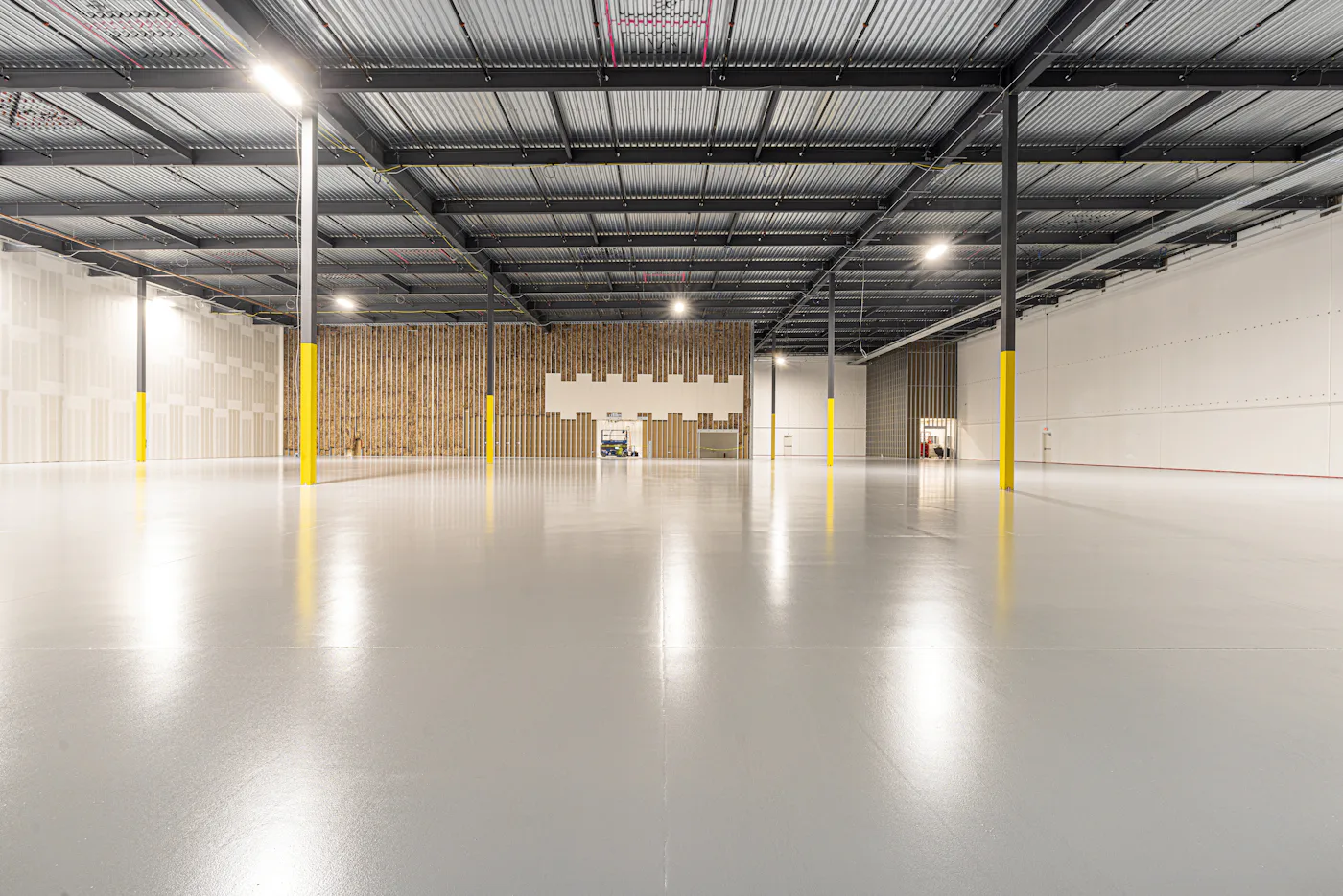
What is epoxy and resin flooring?
Resin flooring is a liquid-applied system that bonds to a prepared concrete slab and cures into a hard, seamless surface. Papa Flooring is a commercial epoxy flooring contractor installing epoxy flooring in Vancouver and across the Lower Mainland, from industrial epoxy flooring in Surrey and warehouse floor coatings in Vancouver to commercial kitchen resin flooring. The right system depends on traffic, chemicals, temperature, moisture and how quickly the space needs to reopen.
System types
"Epoxy" is often used as a catch-all, but there are several distinct families of resin floor. The table compares the ones we most often recommend.
| System | Typical thickness | Strengths | Best for |
|---|---|---|---|
| Thin-film epoxy | Thin roller-applied coats | Dust control, easy cleaning, colour, economical | Light industrial, storage, back-of-house, parkade rooms |
| High-build / self-levelling epoxy | Thicker, trowelled or poured | Smooth, seamless, good impact and chemical resistance | Warehouses, manufacturing, labs, showrooms |
| Urethane cement | Thick, trowelled or slurry | Handles thermal shock, hot water and steam cleaning, more tolerant of slab moisture | Commercial kitchens, food and beverage processing, breweries |
| Flake or quartz broadcast | Varies with build | Textured, slip-resistant, hides wear | Washrooms, locker rooms, ramps, wet areas |
| MMA (methyl methacrylate) | Varies | Very fast cure, including in cold conditions | Spaces that can only close briefly |
Urethane cement is usually our first suggestion for restaurant and hospitality kitchens, because standard epoxy can crack or debond under repeated hot water and temperature swings. MMA is a specialist option we mention when downtime is the main constraint.
Our process
Surface preparation
Most coating failures are preparation failures. We mechanically prepare the slab by diamond grinding or shot blasting to remove laitance, sealers, old coatings and contamination and to open the surface profile so the resin can bond. Acid etching alone is not a substitute for mechanical prep on commercial floors.
Moisture testing
Moisture vapour moving up through a slab is a leading cause of blistering and delamination in resin floors. We test slab moisture before specifying a system. Where readings are high, options include a moisture-tolerant primer, a moisture mitigation layer or a system such as urethane cement that is more forgiving.
Repairs, primer and build coats
Cracks, spalls and joints are repaired, then the primer and body coats go down. For broadcast systems, flake or quartz aggregate is seeded into the wet resin and locked in with a topcoat.
Cove bases, striping and safety zones
Integral cove bases carry the resin up the wall to create an easy-clean junction with no gap for water or debris. In warehouses we add line striping for traffic aisles, pedestrian walkways, forklift zones, racking and hazard areas, so the floor helps organize the space.
Cure and return-to-service times
Return-to-service depends on the product, the number of coats and the temperature and humidity on site. As a general guide:
- Epoxy systems typically allow light foot traffic within about a day and full service after several days
- Urethane cement is typically ready for foot traffic within a day, with full chemical resistance after a longer cure
- MMA typically cures in hours, which is why it is chosen for short shutdowns
Cold slabs slow cure, so we plan heating and ventilation for winter jobs in unheated buildings.
Where it works best
- Warehouses, distribution and manufacturing
- Commercial kitchens, bakeries, breweries and food processing
- Washrooms, locker rooms and janitorial rooms
- Mechanical rooms, loading areas and service corridors
- Showrooms and retail spaces wanting a seamless coloured floor
We install resin floors throughout the region, including industrial areas in Surrey, logistics buildings in Richmond and commercial spaces in Vancouver.
Choosing the right option
A few questions point to the right system:
- Is there heat or hot water? Urethane cement is usually the better choice.
- Is the floor wet or greasy? Add a broadcast texture for slip resistance.
- Is there forklift traffic? High-build systems and repaired joints hold up better than thin films.
- How long can the space close? That may decide between epoxy, urethane cement and MMA.
- Does it need a coating at all? For dry spaces that just need a durable, attractive floor, polished concrete may be simpler.
Ask about texture early. A very smooth, glossy coating looks great but can be slippery when wet. Texture is easy to build in during installation and hard to add later.
Planning your project
We start with a site assessment covering slab condition, moisture, chemicals in use, traffic and your schedule. You receive a line-item proposal and a single point of contact. For operating facilities we can phase work by zone or schedule after hours and on weekends. If the slab needs significant repair or levelling first, our subfloor prep crew handles it, and for wet areas that need extra traction see safety and anti-slip flooring. To get started, Request a Consultation or send us your drawings.
Frequently asked questions
What is the difference between epoxy and urethane cement flooring?
Epoxy is a hard, chemical-resistant resin suited to warehouses, labs and dry service areas. Urethane cement handles hot water, steam cleaning and temperature swings better, so it is the usual choice for commercial kitchen resin flooring and food processing.
How long before we can use the floor?
Epoxy typically allows light foot traffic within about a day and full service after several days. Urethane cement and MMA can be faster. Temperature and humidity on site affect cure, so we confirm timing in your schedule.
Why do epoxy floors peel?
The most common causes are poor surface preparation and moisture vapour coming up through the slab. We prepare floors by diamond grinding or shot blasting and test moisture before choosing a system.
Can you add line striping to a warehouse floor coating in Vancouver?
Yes. We add striping for aisles, pedestrian walkways, forklift zones and hazard areas as part of the coating, or to an existing sound floor.
Is epoxy flooring slippery?
A smooth, glossy coating can be slippery when wet or oily. Adding flake or quartz broadcast or an anti-slip additive gives texture and better traction in wet areas.