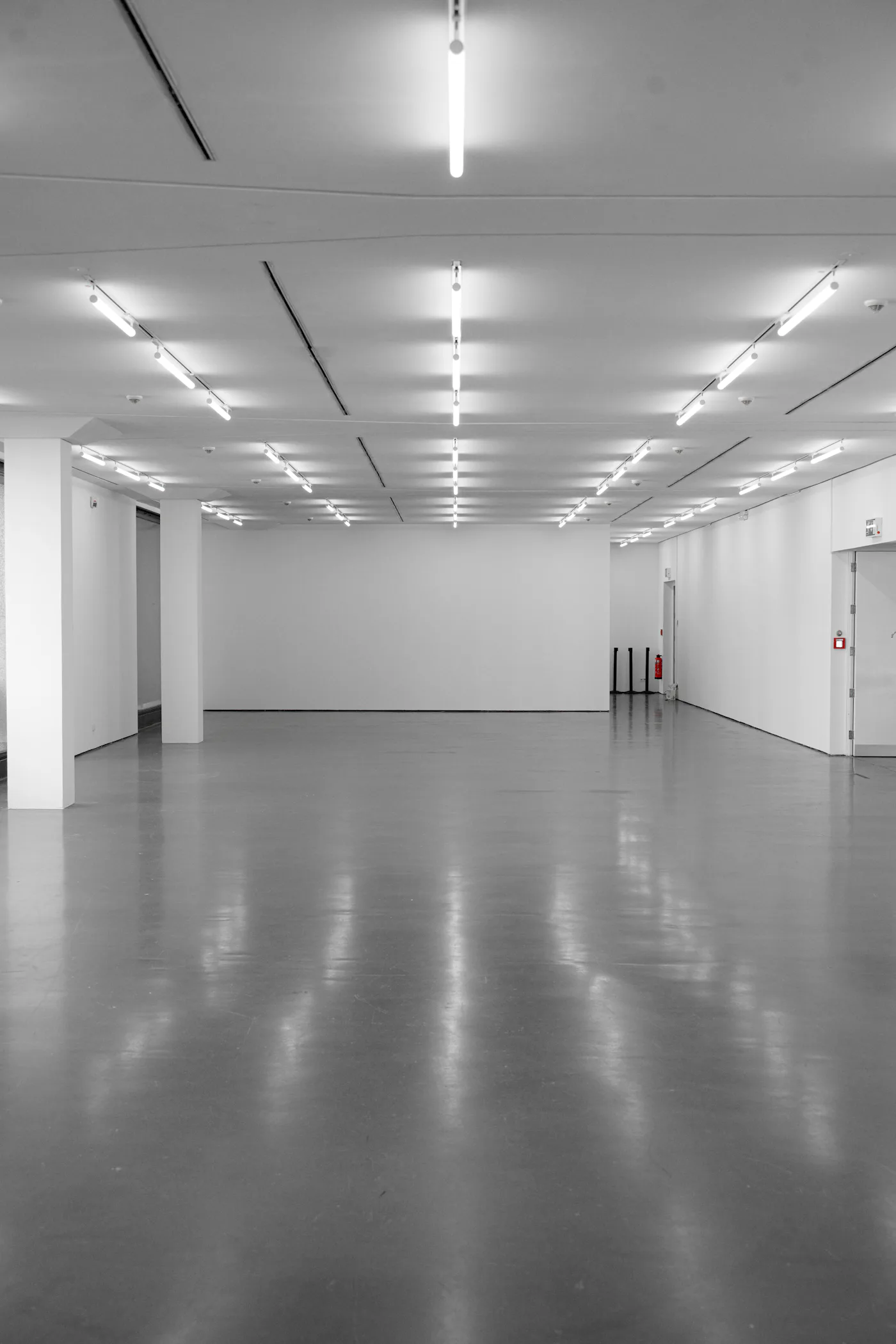
What is polished concrete?
Polished concrete is a structural slab that has been mechanically ground, hardened and refined until it takes on a smooth, reflective finish. Nothing is laid on top of it, so there is no covering to peel, delaminate or wear through. Papa Flooring is a concrete polishing contractor serving Vancouver and the wider Lower Mainland, working for general contractors, property managers and business owners who want a durable floor that is simple to keep clean. We handle polished concrete in Vancouver, polished concrete floors in Burnaby and Surrey, and warehouse concrete polishing across BC's Lower Mainland.
Because the finish comes from the slab itself, the result depends on the concrete you start with, which is why every job begins with a site assessment.
Our process
Every polished floor follows the same sequence. The number of passes changes with slab hardness, surface condition and the finish you want.
1. Grind
Coarse metal-bond diamonds remove contaminants, high spots, old coatings and laitance, and set how much aggregate is exposed. Machines run with connected dust extraction.
2. Hone
Finer diamonds remove the grinding scratch pattern so the floor looks even from wall to wall.
3. Densify
A chemical densifier, typically lithium or sodium silicate, is applied to react with the concrete and harden the surface. This improves abrasion resistance and helps the floor hold its polish.
4. Polish
Resin-bond diamonds take the floor up through progressively finer grits until it reaches the agreed sheen level.
5. Guard
A penetrating stain guard is applied and burnished in. It is not a thick coating, but it slows staining from oil, coffee and other spills.
Choosing the right option: sheen and aggregate exposure
Two decisions shape the look: how deep we grind (aggregate exposure) and how far we polish (sheen).
| Option | What you see | Typical use | Notes |
|---|---|---|---|
| Cream finish | The smooth top paste of the slab, little or no stone visible | Offices, galleries, minimalist retail | Needs a very consistent slab; trowel marks and patches can show |
| Salt-and-pepper | Fine sand and small aggregate flecks across the surface | Showrooms, lobbies, restaurants | A light grind; a popular balance of look and cost |
| Full aggregate exposure | Larger stones cut through, like a terrazzo-style surface | Feature lobbies, high-end retail | Deeper grinding and more passes; results depend on the stone in the mix |
| Satin sheen | Low reflection, soft appearance | Warehouses, back-of-house, busy entrances | Hides wear and scuffs well |
| Semi-gloss sheen | Clear reflection of overhead light | Retail floors, offices, showrooms | Brightens spaces and helps with lighting |
| High-gloss sheen | Mirror-like reflection | Showrooms and feature areas | Most passes; best suited to good-quality slabs |
New slabs vs existing slabs
On new construction, polished concrete works best when planned before the pour. Mix design, finishing and protection from trades, paint, drywall mud and hydraulic leaks all affect the final floor.
Existing slabs are just as common, especially in tenant improvements and older warehouses. Typical work on an existing slab includes:
- Removing old carpet, vinyl, VCT, tile and the adhesive left underneath
- Grinding off paint, coatings and residue
- Repairing cracks and spalled areas with a colour-matched or contrasting repair material
- Filling control joints with a semi-rigid filler so forklift and pallet-jack wheels do not break joint edges
- Evaluating stains and patches that will remain visible after polishing
Old patches, saw cuts and adhesive shadows will not disappear entirely, and we explain that at the assessment. If the surface needs more than polishing can give, our subfloor prep and levelling team can recommend another approach.
Where it works best
Polished concrete suits spaces with heavy foot traffic, rolling loads and a need for low long-term upkeep:
- Retail stores and showrooms
- Warehouses and distribution centres
- Building lobbies and corridors
- Offices and creative workspaces
We work across the region, including Vancouver, Burnaby and Surrey, where many business parks and industrial units sit on slabs that are well suited to polishing.
Maintenance
Polished concrete needs no wax, no stripping and no recoating cycle. Daily care is dust mopping and wet cleaning with a pH-neutral cleaner. In larger spaces, an auto-scrubber with a suitable pad keeps the floor clean and helps maintain the shine. High-traffic areas can later be re-burnished rather than replaced.
Keep it simple. Avoid acidic or harsh cleaners and topical waxes on polished concrete. They can dull the surface or leave a film that makes it look patchy.
When polished concrete is not the right choice
Polished concrete may not suit areas with standing water, strong acids or constant chemical exposure, such as commercial kitchens, where a resin system is usually better. Badly damaged or very soft slabs may not polish evenly. If you need a seamless, coloured or chemical-resistant finish, see our epoxy and resin flooring. For softer, quieter office areas, carpet tile may be the better fit.
Planning your project
We look at slab condition, existing coverings, access, power, dust control and whether the space will be occupied. We can phase work or schedule it after hours and on weekends for operating businesses, and you get a line-item proposal and a single point of contact from assessment through to clean handover. To book a site assessment, Request a Consultation or call (778) 933-7272.
Frequently asked questions
How long does it take to polish a concrete floor?
It depends on floor area, slab condition, prep and the finish you choose. We give you a schedule after the site assessment and can phase work so parts of the building stay open.
Can you polish an existing concrete floor in an older building?
Often, yes. We remove old flooring and adhesive, repair cracks and fill joints before grinding. Older slabs can show patches, stains and saw cuts, so we review what will remain visible before work starts.
Is polished concrete slippery?
A clean, dry polished floor typically has good traction for normal foot traffic. Like most hard floors, it can become slippery when wet or contaminated, so entrance matting and prompt spill cleanup matter. In wet areas, a textured resin system may be a better choice.
Do you offer warehouse concrete polishing in BC?
Yes. We polish warehouse and industrial floors across Greater Vancouver, including joint filling for forklift traffic and a satin or semi-gloss finish that brightens the space and is easy to clean with an auto-scrubber.
What maintenance does polished concrete need?
Regular dust mopping and cleaning with a pH-neutral cleaner, or an auto-scrubber in larger spaces. There is no waxing or stripping. High-traffic areas can be re-burnished or lightly re-polished when they start to look dull.