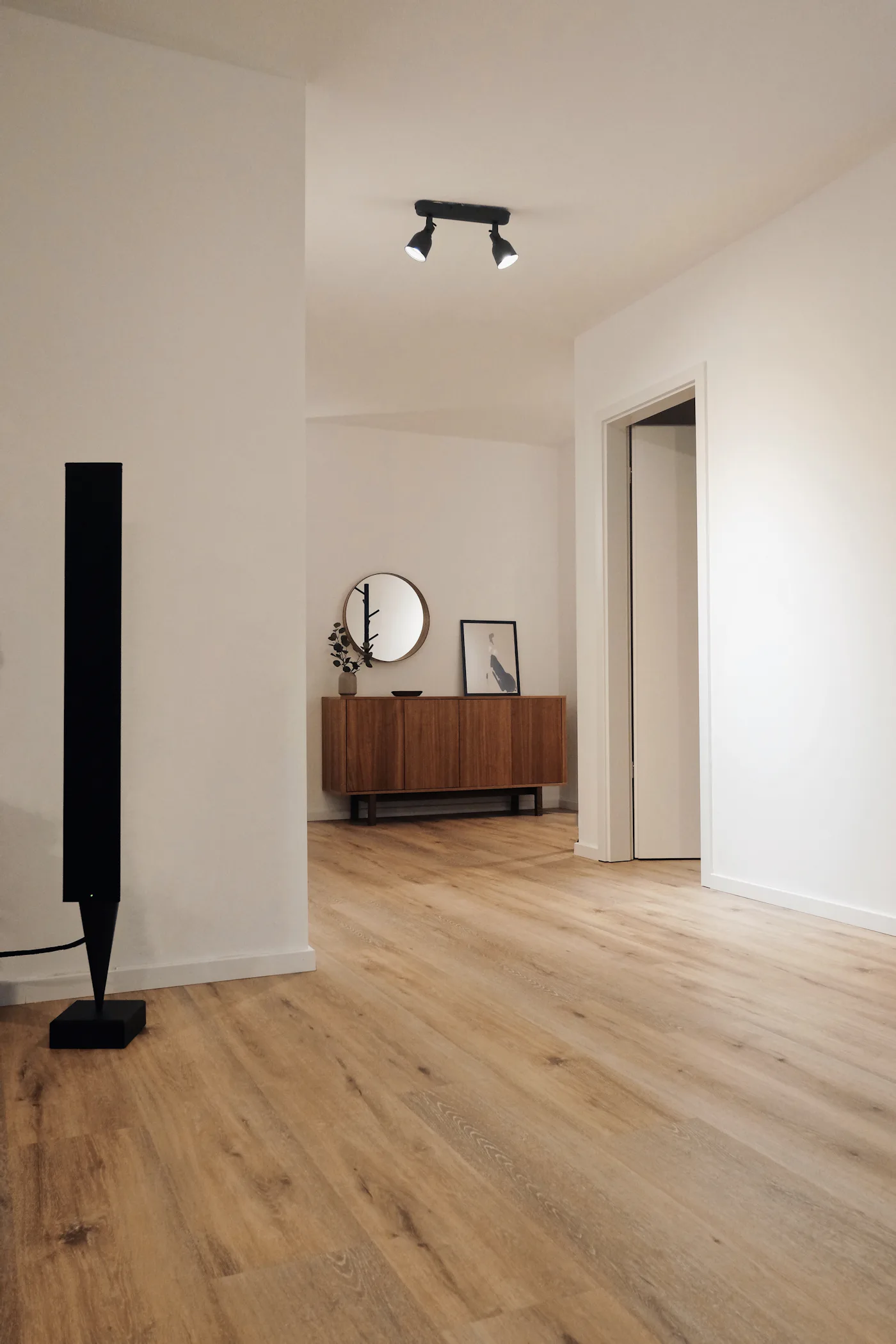
Why most flooring failures start below the floor
When a commercial floor bubbles, curls, cracks or comes loose, the cause is often underneath it: moisture in the slab, old adhesive, an uneven surface or a weak top layer of concrete. The finished flooring gets the attention, but the subfloor decides how long it lasts. Papa Flooring provides floor levelling in Vancouver and across the Lower Mainland, including self-levelling concrete, concrete grinding and floor prep, and moisture testing of concrete subfloors, either as part of our own flooring installations or ahead of another finish.
Our process
1. Site assessment
We look at the existing flooring, the slab or wood subfloor, visible cracks and joints, the flooring you plan to install and your schedule. This tells us which tests and repairs are needed before we write the proposal.
2. Moisture testing
Concrete holds water long after it looks dry, and Lower Mainland slabs can also pick up moisture from below grade. The current standard for commercial projects is in-situ relative humidity testing to ASTM F2170, where probes are placed in drilled holes at a set depth and left to equalize before reading. The older calcium chloride test, ASTM F1869, measures moisture emission at the surface and is still referenced by some manufacturers. We compare results to the limits for the specific flooring and adhesive being installed.
3. Moisture mitigation
If readings exceed those limits and the schedule cannot wait for the slab to dry, a moisture mitigation system can be applied. These are typically epoxy-based or specialty primers that reduce vapour transmission to a level the flooring can tolerate. The right system depends on the readings and the manufacturer's requirements.
4. Removing old flooring and adhesive
Old carpet, vinyl, VCT, tile and their adhesives need to come off cleanly. Leftover residue can react with new adhesives or telegraph through thin flooring. In older buildings, some flooring products and adhesives may contain asbestos. Suspect materials must be tested before they are disturbed, and if asbestos is found, it must be removed by a qualified abatement contractor following WorkSafeBC requirements. We do not perform asbestos abatement, and we start our work once the area has been cleared.
5. Grinding
Diamond grinding with dust extraction removes adhesive, coatings, high spots and weak surface concrete, and opens the surface so primers and levellers bond. It is also the first step for polished concrete and resin coatings.
6. Crack and joint repair
Non-moving cracks are typically filled with a rigid repair material. Control joints and moving cracks need a different approach, since filling them rigidly under certain floor finishes can lead to cracks reflecting through. We review joint treatment against the flooring manufacturer's guidance.
7. Priming and levelling
Primers seal porous concrete and help levelling compounds bond. Then the surface is patched or levelled to the required flatness.
Choosing the right option: patching vs self-levelling
| Approach | What it does | When it fits |
|---|---|---|
| Skim coat / patching | Trowelled compound fills low spots, divots and small depressions | Mostly flat floors with isolated defects |
| Self-levelling underlayment | Pourable cement-based compound flows out to create a flat, smooth surface | Larger areas out of tolerance, uneven slabs, preparing for LVT or sheet vinyl |
| Grinding high spots | Removes ridges, humps and trowel marks | Used with patching or levelling to bring a floor into tolerance |
Self-levelling concrete is the most reliable way to flatten a large area quickly. It typically accepts foot traffic within hours and can receive flooring after a day or more, depending on thickness, product and site conditions.
Flatness tolerances
Flooring manufacturers set flatness requirements, often as a maximum deviation over a set distance, such as a few millimetres over a 3 metre straightedge. Large slabs in warehouses and new construction may also be specified with F-numbers: FF for flatness and FL for levelness. Higher numbers mean a flatter, more level floor. Thin resilient flooring such as LVT and sheet vinyl is the least forgiving, while carpet tile tolerates a little more variation.
Test early. Moisture testing takes time because ASTM F2170 probes need to equalize before reading. Building testing into the schedule early avoids last-minute delays before installation.
Where it works best
Every flooring project benefits from proper prep, but it matters most in tenant improvements in older office buildings, healthcare fit-outs where sheet vinyl must be flat and seamless, and retail conversions with years of patches and old adhesive. We work across Vancouver, Coquitlam and Langley.
Planning your project
Subfloor work timelines depend on slab condition, the amount of removal, moisture readings and cure times for primers and levellers. Typically, testing and prep are scheduled several days to a few weeks ahead of flooring installation on larger projects. We give you a line-item proposal that separates prep from installation, so you can see exactly what the floor needs, and we can work after hours or in phases. Request a Consultation or send us your drawings to book a site assessment.
Frequently asked questions
Why does a concrete subfloor need moisture testing?
Excess moisture in concrete can break down adhesives and cause flooring to bubble, curl or debond. Moisture testing to ASTM F2170 tells us whether the slab is within the flooring manufacturer's limits or needs mitigation first.
What is the difference between patching and self-levelling?
Patching fills isolated low spots on an otherwise flat floor. Self-levelling concrete is poured over larger areas to create a flat, smooth surface when the floor is out of tolerance across a wider area.
How long does self-levelling concrete take to dry?
It typically takes foot traffic within hours and can receive flooring after a day or more, depending on thickness, product and temperature. Thicker pours and cooler conditions take longer.
Do you remove old flooring that might contain asbestos?
No. Suspect materials in older buildings must be tested, and asbestos-containing materials must be removed by a qualified abatement contractor under WorkSafeBC requirements. We start our concrete grinding and floor prep once the area is cleared.
Can you level a floor in an occupied building?
Often, yes. We can phase floor levelling in Vancouver-area buildings by zone and schedule work after hours, with dust extraction on grinding equipment.